Interview: Moonglow
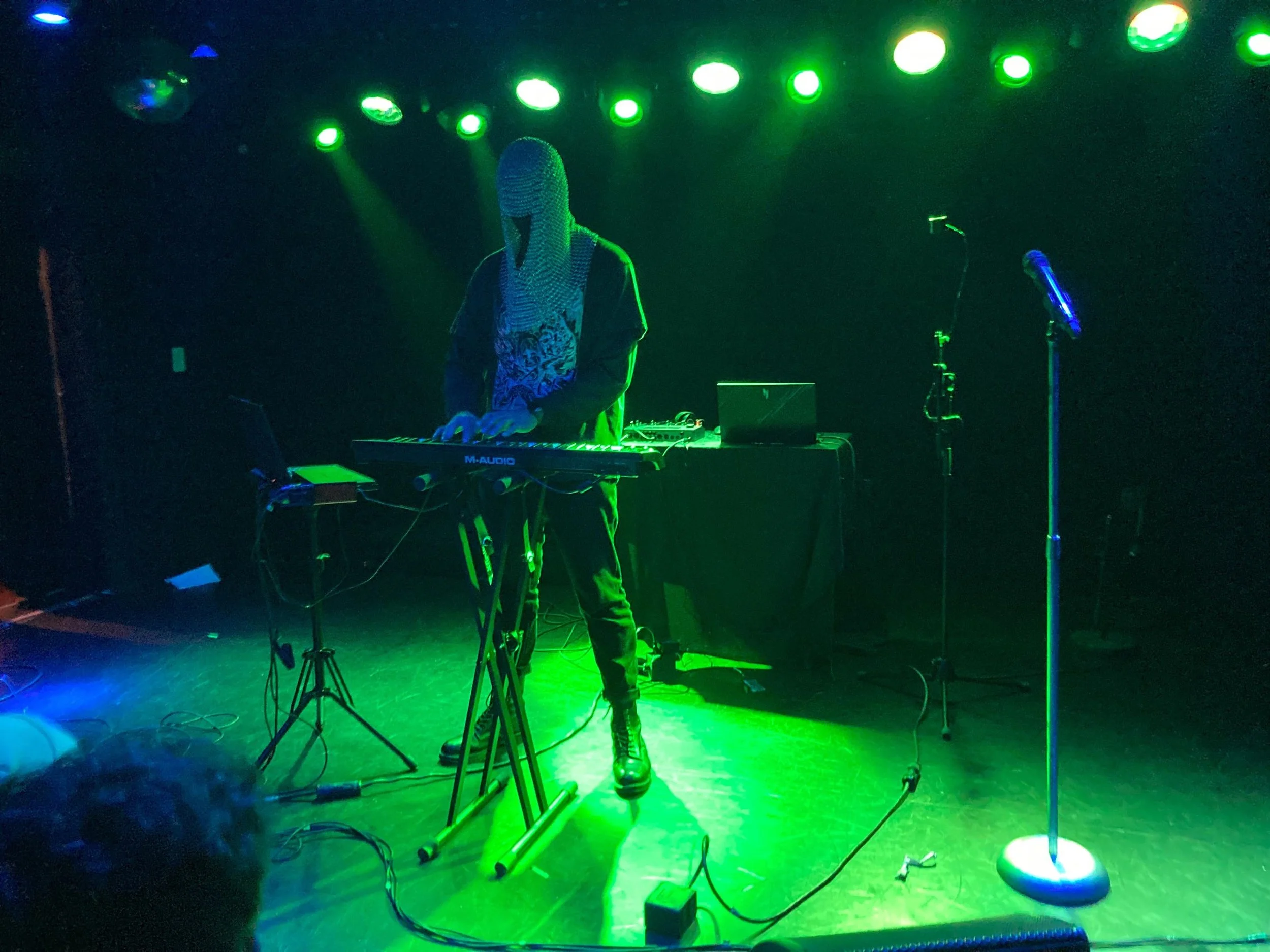
Pictured: Moonglow; Photo: Sean Glaze
Moonglow is a LA-based dungeon synth project whose second album, The Wanderer, arrived in early 2026 as one of the year's more distinctive genre entries: a record that fuses medievalism with 80s darkwave undercurrents and builds, track by track, the sensation of an entire world. It's orchestral and transportive. We sat down with the project's architect, Matt, to talk about where that world came from, how a Moonglow song actually gets built, what the Dark Souls series has to do with hope, and what it was like to take all of this to a live stage for the first time.
How do you describe Moonglow's music to someone who's never touched dungeon synth before? What's the pitch?
With Moonglow I try to capture dreamy fantasy and mythological images of stories you might not be fully privy to the details of. I remember reading an interview with Hidetaka Miyazaki about, if I'm remembering correctly, him as a kid reading fantasy stories where he wasn't able to fully understand all of the words in them, but his imagination filled in the gaps, sometimes possibly making the stories more interesting, or at the very least providing a tantalizing mystery. I like Moonglow to capture a similar feeling, where there could be familiar aspects mixed with whatever it is in your imagination or dreams that could fill the gaps, or just add to the sense of mystery. So if all that sounds interesting to you and you like driving, epic atmospheric soundscapes, Moonglow could be for you!
The Wanderer has a genuinely distinctive spine. It has a darkwave undercurrent with 80s-inflected beats pulsing beneath the medievalism. Where did that fusion come from? Was it a conscious decision going into this record, or did it emerge in the process?
A lot of my songs are found in the process of writing. For the most part I haven't had that much of a plan around a specific image I was trying to conjure with the music. When coming up with the song titles, I'll listen to the finished track on repeat and see what images it evokes in my mind. My biggest influence for Moonglow is probably, unsurprisingly, Summoning. I've been really into them for a long time and have always found their music very unique and inspiring. I've also gotten into a lot of neoclassical darkwave, both on my own and somewhat through reading about Summoning's own influences, so some of the mood of those bands can be heard in my music as well.
The Wanderer feels like a constructed world. Is world-building as a form of meaning-making part of what drives the project? What is The Wanderer actually wandering toward?
The Wanderer is my first album where I was trying to do a little more world-building. It hasn't been fully fleshed out, but I think that might also be part of the appeal of the type of imagery I try to conjure. I pictured a whole fantasy world set on a planet almost entirely comprised of one vast forest. When I was younger I always enjoyed walking in the woods and always felt they were inherently imbued with some kind of awe, and I tried to capture some of that with The Wanderer. As for the titular Wanderer, as in "The Wanderer in Winter," I imagined a cloaked herald to a Celtic-inspired Otherworld who is seen in a deep snowstorm, where people who follow them are led from their own world into another.
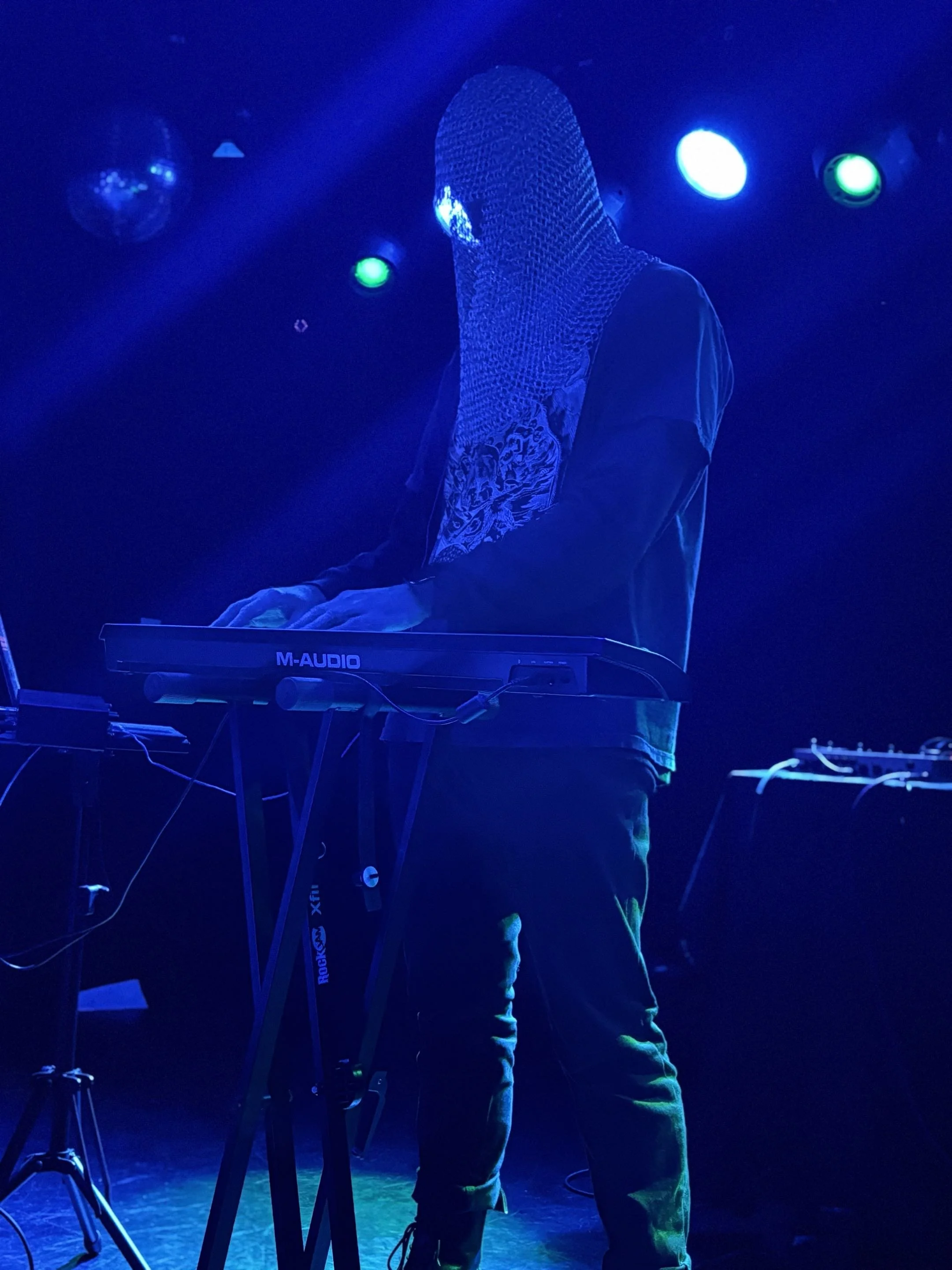
Pictured: Moonglow; Photo: Sean Glaze
"Shores of Dust and Ash" stood out to me as the album's emotional core. There's something in that track about confronting vastness and choosing to read it as possibility rather than void. Is that tension between despair and determination something you were working through consciously?
I really like that interpretation of "Shores of Dust and Ash." The song wasn't intentionally about this, but as I was listening to it, images of the Ringed City from Dark Souls III came to mind, where there are all these different buildings and architecture from different eras all stacked on top of each other and toppling over. I think a lot of the Dark Souls games capture that type of mood: things are obviously very dark, but that is not the only thing that exists, and there is a way to find hope, or small glimpses of beauty and light, through all the darkness.
When looking into the album, I learned that "Nosferatu Zodd" is a character from the series Berserk. I haven't dived into the manga or anime yet, but I tend to love what I hear about it. What does that character or that series mean to you, and what were you trying to capture sonically with that piece?
"Nosferatu Zodd" was one of the few songs where I decided to write something specifically to fit the personality and mood I got from him in both the anime and manga. I haven't read all of the manga, so I'm not fully brushed up on all my lore, but I wanted to evoke a kind of frenzied, animalistic, evil war-chant energy. He is a looming and oppressive figure, and I thought capturing that in a song would be interesting.
The synth layering on this album is orchestral in scope. It's intricate enough that songs exceeding five minutes never feel like they're dragging. Walk me through how a Moonglow piece comes together. Do you start with a concept or a melody?
Moonglow songs almost always start with a melody. Sometimes what I start with ends up being a main melody; sometimes it ends up as something more subtle in the mix, like a backing choir or a synth pad. I then usually build on that melody until I have a whole section built out, drums included. My goal from there is to build toward it: I'll take elements from the main loop, sometimes change them, or strip elements away to build over time toward the climax. Often the song will lead me down paths I didn't expect, and sometimes I end up with a more interesting melody than the one I originally wrote. I've even had songs where I did away with the entire original melody because I discovered something I liked more. I try to vary things enough that it doesn't sound like the same idea repeating too long, and I usually like to bring things down for a rest before driving back into a fuller climax toward the end.
There's a real arc from the howling-wind opening to "The Crystalline Age," gathering everything into a kind of panoramic resolution. How much of that shape was planned versus discovered in the editing?
"The Crystalline Age," if I remember correctly, was one of the later songs I wrote for the album. I thought it sounded like a harbinger of a coming different age, slowly plodding toward the world. As with most of my songs, it was mostly discovered through the writing and arranging rather than planned out beforehand. I like to go with my instincts and follow whatever sounds like it flows well or feels interesting.
"Skyward Rumination" is one of the more contemplative moments. It has a kind of church-bell quality, and that sense of gazing upward into something vast. What were you reaching for there, and how did it find its place in the record's flow?
"Skyward Rumination" started, as is typical for me, with the melody and writing first. While working on the song, my mind was brought to an image from Dark Souls III: a meditating humanoid dragon facing Archdragon Peak. A lot of what dragons represent in the Souls games is about immortality and humanity's quest for it, the desire to become like the dragons. But as with "Shores of Dust and Ash," the themes could just as easily be about contemplating your place in the world and universe, or having some kind of awakening experience.
You do live shows, correct? How has it been taking Moonglow into a live setting?
To this date I've only done one live show, but hopefully I'll be able to do more soon! I was very lucky to open for Hole Dweller when he came to LA in December of 2025, and I'd never performed anything outside of a rock or metal setting before, so there was a lot of learning and research I had to do to figure out how to play Moonglow live. I'll also admit I am not the most skilled keyboard player; it is not my primary instrument, so I don't always fully play out each melody on the keyboard when I'm writing. There was some real learning of my own songs involved just to perform them. I do think the whole experience made me a much more confident keyboard player, though. For future shows, I'd definitely like to work in some more meditative, dreamlike imagery and more interesting costuming, to really fully transport the audience into another world.
Who in the current dungeon synth underground are you paying attention to? Anyone you think is doing something genuinely interesting that doesn't get enough light?
I'm still somewhat of a newcomer to the dungeon synth scene, so there aren't a lot of deep-cut acts on my radar yet. As I've said, my entry point was Summoning and their approach, but I always check out pretty much anything put out by Dungeons Deep, which is still an honor to be released by. One of my favorites they've put out is Legends of the Dragon Forge by Mournbound: some really interesting soundscapes and melodies, an overall really cool vibe.
Does living in LA add to the chaos, wonder, whimsy, and terror your music can conjure?
If anything, I'd say Moonglow provides an escape from a lot of the concrete and highways of LA. A lot of LA's surrounding nature is very beautiful, and some of the most awe-inspiring skies I've seen have been while living out here, so there's a little bit of escapism from some of the more mundane aspects of daily life in my music, as well as a constant inspiration drawn from the natural world.
You can follow Moonglow on Bandcamp, Spotify, and Instagram.
